
Music Industry Explained / Vesta Journal
Managers, Agents, and Music Companies: Who Does What for an Artist?
Who books the show, plans the career, pitches the interviews, and keeps everything moving? Learn how managers, booking agents, promoters, publicists, and other music professionals work together, and how to build a team around the support you need.

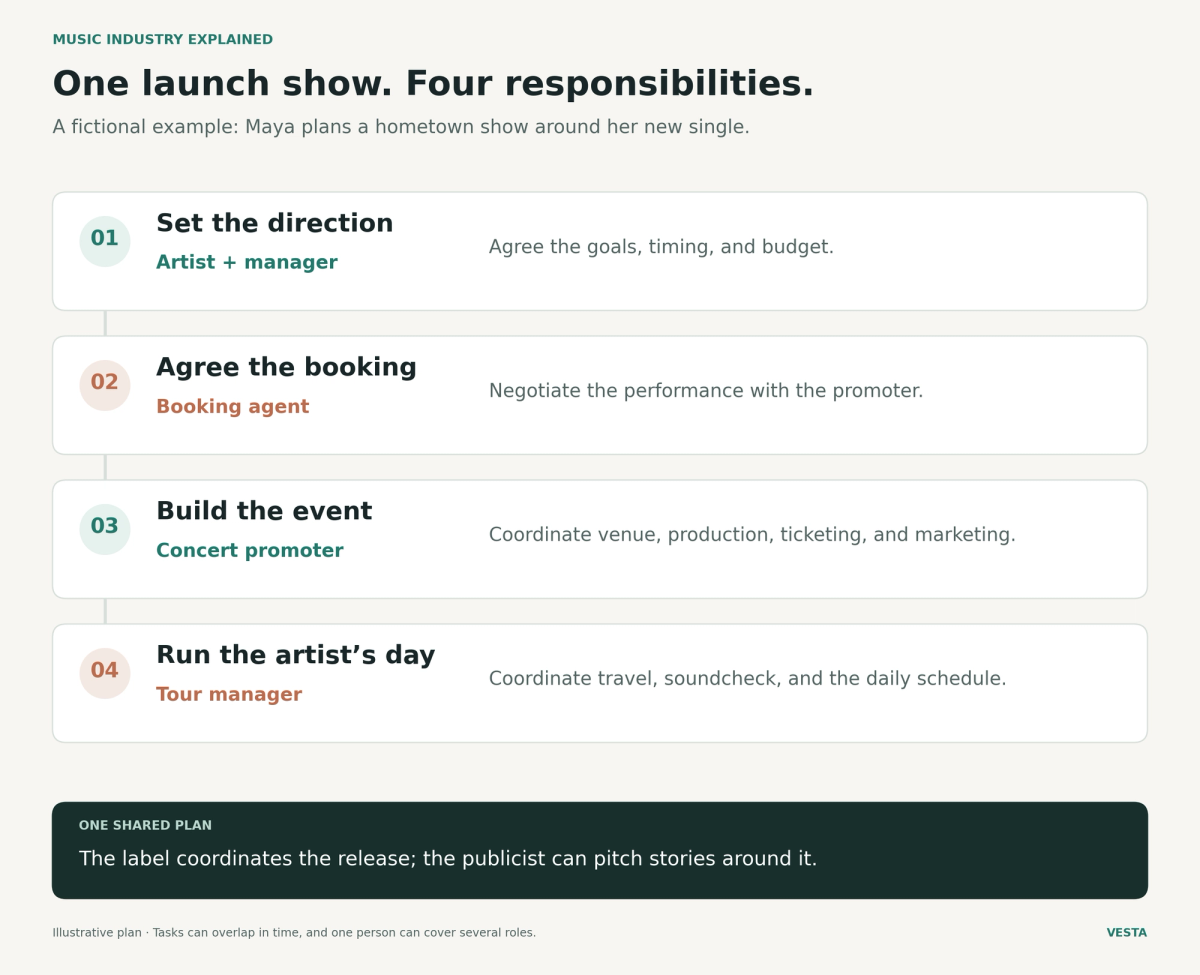
Maya has a new single coming out and wants to celebrate with a hometown show. Someone needs to organize the release, approach venues, arrange interviews, and make sure she reaches soundcheck on time.
Who handles all of that: her manager, her label, or an agent?
The music business has a title for almost every responsibility. Understanding those titles helps you work out what support you need and what you can already handle yourself.
An artist’s team can grow around the work that needs doing. Here is how its main roles fit together, following Maya’s fictional release and launch show.
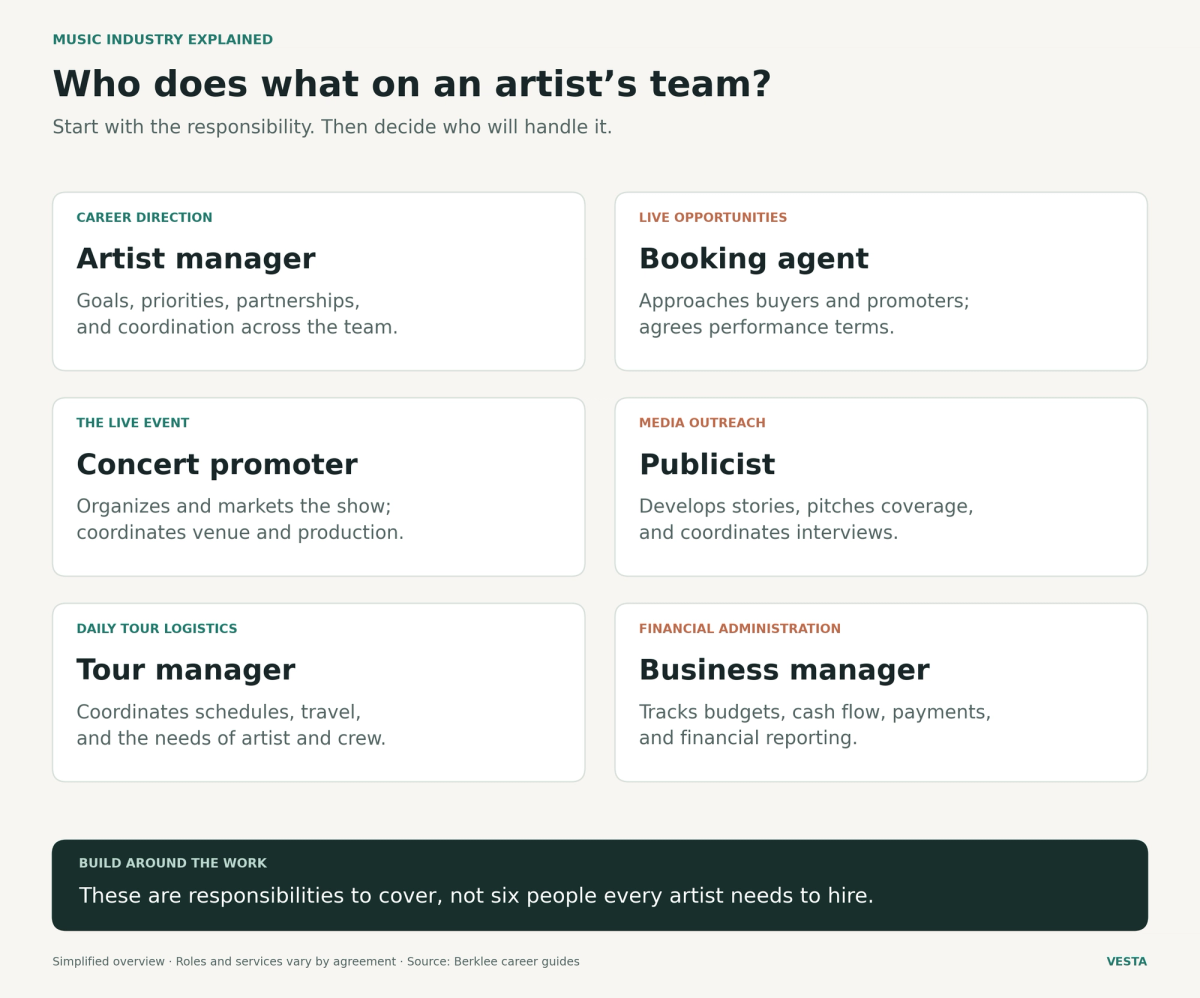
The artist manager: connecting the bigger picture
An artist manager helps guide the artist’s career and coordinate the people and opportunities around it.
For Maya, that could mean deciding how the single fits into a longer release plan, discussing potential partnerships, keeping the campaign moving, and making sure a show supports her goals.
The manager is often a central point of contact between the artist, label, booking agent, and other collaborators. Their responsibilities vary with the relationship: one manager might be deeply involved in daily project work, while another has a wider team handling execution.
At this stage, Maya’s manager might ask: “What do we want this release and show to achieve, and who is responsible for each part?”
The booking agent: securing live opportunities
A booking agent represents the artist in arranging live performances. This can involve approaching promoters and talent buyers, discussing fees and terms, and fitting dates into a workable schedule.
For Maya’s launch, the agent might explore a suitable club date or an opening slot with an artist whose audience overlaps with hers.
Booking agencies can represent several artists, sometimes across different territories. The exact scope of representation matters: an agent handling live shows should not automatically be assumed to manage the artist’s recordings or entire career.
The agent’s question is: “Where should Maya play, and on what terms?”
The concert promoter: making the event happen
A concert promoter organizes and markets the live event. Depending on the arrangement, this can include securing a venue, coordinating production and ticketing, promoting the show locally, and taking on its financial risk.
The promoter and booking agent may negotiate opposite sides of the same performance agreement. The agent represents the artist; the promoter is putting on the event.
A venue may promote its own shows or work with an outside promoter. At a small independent event, one person may cover several of these responsibilities.
For Maya’s launch, the promoter’s question is: “How do we deliver a successful show and bring the audience into the room?”
The publicist: getting the story in front of the media
A publicist develops and pitches an artist’s story to relevant media. That might involve press materials, interview proposals, reviews, features, and coordinating media appearances around a release or tour.
For Maya, the useful story might be the local scene behind the single or the personal experience that inspired it. The publicist shapes that angle and approaches outlets whose audiences could care about it.
Publicity and advertising are different activities. A publicist may pitch a journalist for coverage, while an advertising campaign buys placements. A press pitch does not guarantee that an outlet will publish a story.
The publicist’s question is: “Why is this artist interesting to this audience right now?”
The tour manager: keeping the artist’s day running
Once dates are booked, the artist still needs to get through them.
A tour manager coordinates the practical side of touring: schedules, travel, communication with venues, and the daily needs of the artist and crew. They can also track tour spending and handle show-related administration.
For Maya, that might mean confirming arrival time, soundcheck, the interview slot, and the trip home. On a small run, the artist or another trusted team member may take responsibility for these tasks.
The tour manager’s question is: “Does everyone know where to be, when to be there, and what they need?”
The business manager: keeping track of the finances
An artist manager and a business manager are different roles.
A business manager focuses on financial administration, which can include budgeting, cash flow, payments, accounting coordination, and working with tax specialists.
For Maya, the immediate need may simply be reliable bookkeeping and a clear record of release and show expenses. A more extensive business-management arrangement can become useful as the operation grows.
The question here is: “What came in, what went out, and what commitments are coming next?”
Where do labels, distributors, and publishers fit?
These partners work alongside the artist’s wider team.
- The record label supports the recordings and release campaign according to its agreement with the artist.
- The distributor handles delivery to music services and the related recording-revenue reporting.
- The publisher or publishing administrator works with the underlying compositions and the songwriting business.
Maya’s label, Northside Records, might coordinate the single’s delivery and promotional assets while her manager aligns the release with the show. Her agent and promoter work on the live event, and the publicist pitches relevant stories.
Several companies may contribute to one campaign, but their responsibilities should remain clear.
Do you need all these people to get started?
You can begin with a small team and add support when there is a clear reason.
For an early release, Maya and Northside might manage the schedule themselves, arrange one local show directly, and prepare their own press outreach. As opportunities grow, they can bring in people with the experience and capacity to handle specific work.
Before appointing a partner, agree on the scope, payment arrangements, spending approvals, and how progress will be communicated. A title is useful when everyone understands the responsibilities behind it.
For a new label, this is also a way to define your offer. Be clear about which work you handle for artists and which services come from outside collaborators.
Vesta White-Label Express gives labels and teams a branded portal for organizing artists, releases, and distribution. Explore the Vesta demo to see how it could support the release side of your operation.
Keep exploring
More articles in Music Industry Explained

Record Labels vs. Music Publishers: Who Handles What?
A record label releases recordings. A music publisher works with the songs behind them. Learn how their roles differ, why one release can generate separate royalty streams, and what artists and independent labels need to keep track of.
Music Distributors Explained: How Your Music Reaches Streaming Platforms
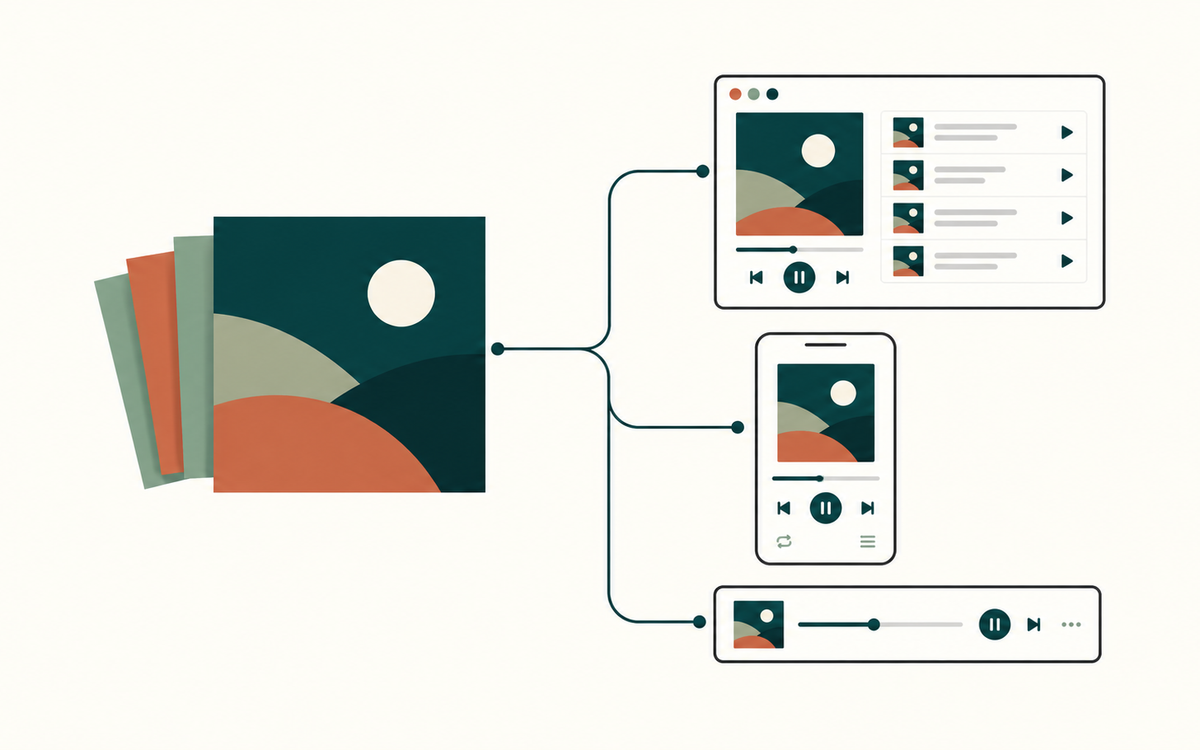
How does a finished recording reach Spotify and Apple Music? Discover what distributors, aggregators, and white-label providers do, how they differ from record labels, and how releases and revenue move through the system.

Record Labels Explained: Major, Independent, and Everything Between
Major labels, independent labels, imprints, and artist-owned companies: what do these names actually mean? Discover how record labels work, how they fit together, and where your own label could belong.